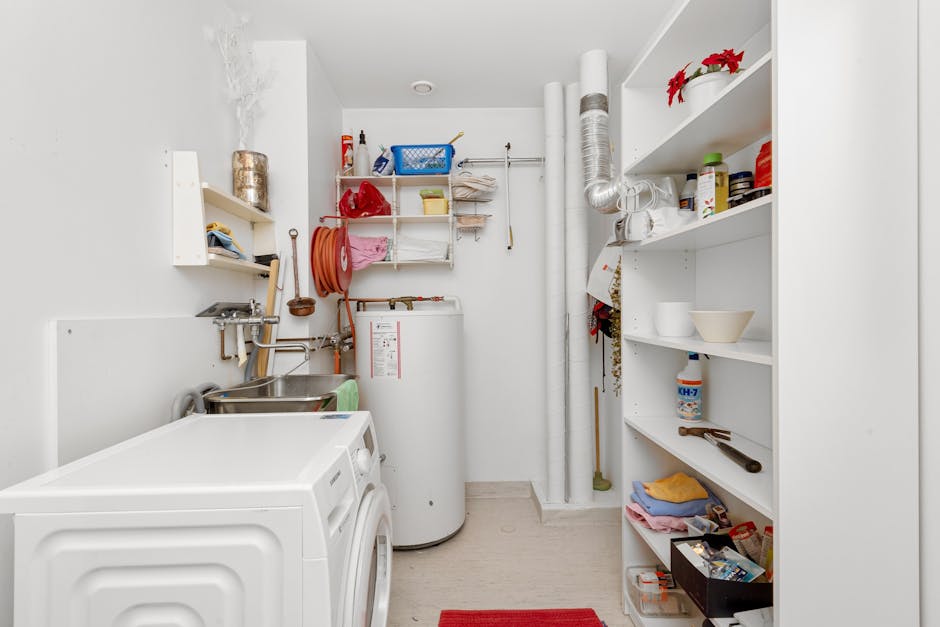
Right now your water heater is having its easiest month of the year. Incoming water off the mains is still warm from summer, showers are short, and the tank barely works to hold 120 degrees. In six weeks that changes. Ground water temperature in Orange County and the L.A. basin drops maybe 15 to 20 degrees between September and January, and your heater has to make up every one of those degrees. A tank that was quietly limping along on an inch of scale and a spent anode rod does not usually fail in August. It fails on the first cold Sunday in December, in a garage, with nobody home.
That is the whole argument for looking at it now. A flush and inspection is a routine, scheduled thing in October. In December it is a flooded garage, a drywall repair, and a rushed replacement decision.
The checklist
Work through these in order. Most of it takes an hour.
- Look at the date on the label. Most manufacturers hide the build date in the serial number — often the first four digits, month and year. A standard tank heater lasts 8 to 12 years here; hard water pushes that toward the short end. Tankless runs closer to 20 if it gets descaled. If yours is past ten, everything below is about deciding when to replace, not whether.
- Check the pan and the floor around the base. Rust stains, a chalky white ring, or a damp spot at the seam means the tank is already weeping. That is not a wait-until-spring item. A seeping tank is days-to-weeks from an open failure.
- Flush a few gallons off the drain valve. Hook a hose to the valve at the bottom, run it to a driveway or floor drain, and let two or three gallons out. If it comes out looking like weak coffee with grit in it, that is sediment cooking on the burner plate. Do this yearly.
- Listen to it during a heating cycle. Popping, rumbling, or a kettle-like tick is water flashing to steam underneath a scale layer. It means the burner is heating rock before it heats water, and your gas bill reflects that.
- Test the T&P valve. Lift the lever on the temperature and pressure relief valve for a second and let it snap back. You should get a burst of hot water out the discharge pipe. If nothing comes out, or it dribbles afterward, the valve needs replacing. It is the one part standing between a runaway thermostat and a real problem.
- Confirm the seismic straps and the expansion tank. Two straps, upper and lower third of the tank, are code in California. The expansion tank is the small football-shaped tank on the cold inlet. If either is missing, it was a cheap install.
- Set the thermostat to 120 degrees. Higher than that scalds and accelerates scaling. Lower than 120 invites bacteria growth in a tank that sits.
- Have the anode rod checked. This is the sacrificial magnesium or aluminum rod that corrodes so the steel tank doesn't. In our water it can be eaten down to bare wire in three to five years. Replacing a $40 rod is the single cheapest way to buy a tank another five years.
Why hard water changes the math here
Water across the Inland Empire and much of Orange County runs hard — commonly 10 to 20 grains per gallon depending on the district and the blend of imported versus local groundwater. Every gallon heated leaves calcium behind. That is why the same tank that lasts 14 years in Seattle gives up at nine here.
You can see it elsewhere in the house first: aerators that clog, a dishwasher that leaves film, shower doors that never look clean. Those are the same minerals building on your heater's burner plate and inside the heat exchanger of a tankless. The long-run damage that hard water does to supply lines and fixtures over the years is the same process, just slower and out of sight.
If you have a tankless unit, the fall equivalent of a tank flush is a descaling service — circulating a vinegar or descaling solution through the heat exchanger for 45 minutes. Skip it for three years in this water and you will start seeing error codes and cold sandwiches mid-shower.
DIY versus call a plumber
Honest split. You can safely check the label date, look for rust and moisture, drain a few gallons off the valve, set the thermostat, look at the straps, and clean aerators. That is real maintenance and it costs nothing.
Leave the rest to a licensed plumber. Pulling the anode rod takes a breaker bar and often a second person, and on a corroded tank it can torque the fitting loose. Anything on the gas side — the control valve, the thermocouple, the flue draft — is not a homeowner job. Same for a T&P valve that failed the test, and any full flush on a tank over ten years old, where opening a crusted drain valve can mean it will not close again.
On cost: a service call with a flush and inspection typically runs $100 to $250 nationally. An anode rod replacement, $150 to $350. A T&P valve, under $200. A full tank replacement is generally $1,500 to $3,000 installed, and a tankless conversion $3,500 to $6,500 — the high end driven by gas line upsizing, venting changes, tight attic or closet access, and code items the permit will require anyway, including seismic straps, a drain pan with a routed line, and an expansion tank. Water heater swaps trigger a permit in essentially every jurisdiction here. Local quotes vary; get the number on paper before work starts.
What can wait and what can't
Wait a week or two: rumbling during heat-up, a slightly slow recovery, mildly discolored hot water at the tap. Annoying, not structural.
Do not wait: water pooling at the base, rust weeping from a seam, a relief valve that discharges on its own, or the smell of gas anywhere near the unit. Also treat a sudden change in hot water pressure as worth a look — sediment in the tank and a broken dip tube are common causes, though pressure problems on the cold side can have nothing to do with the heater at all.
If you only do one thing
Find the date on the tank. Everything else follows from that number. Under eight years, flush it and get the anode rod checked and you will likely get another good stretch out of it. Over twelve, start pricing replacement on your schedule instead of on the tank's.